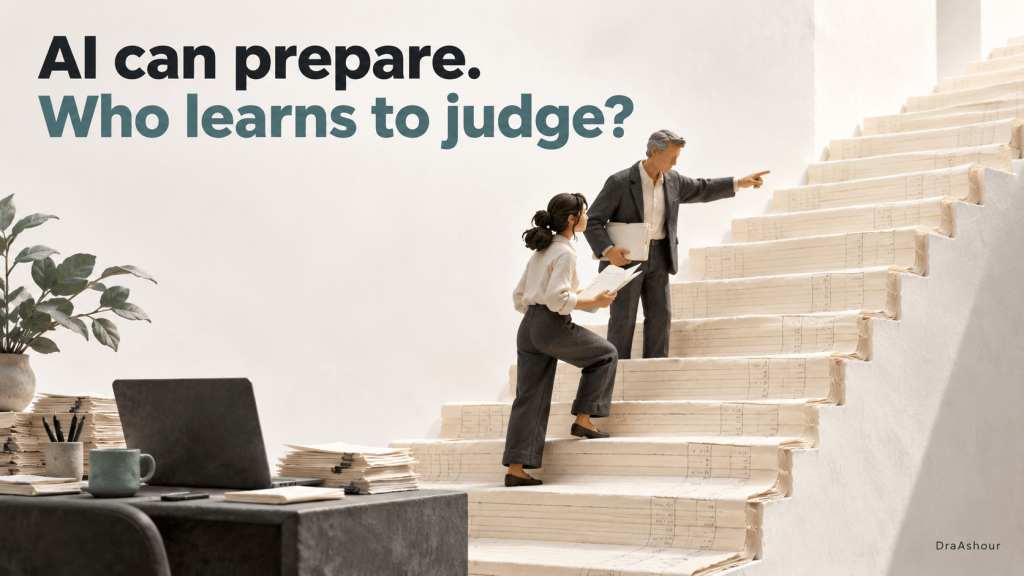
If AI does the junior work, how do junior accountants become senior? That question deserves a place in every accounting firm’s automation plan. A faster first draft is useful. A team that cannot explain the draft still has a problem.
As AI changes entry level accounting jobs, firms can redesign the learning that happens around routine work. A practical approach is to preserve selected preparation exercises, teach evidence based review, and increase responsibility only when a learner can demonstrate the reasoning behind a conclusion.
By Ammar Ashour · U.S. accounting practice perspective · October 12, 2026. This article offers an editorial training proposal, not findings from the author’s doctoral study or a forecast of job losses.
Why this is a timely accounting question
AICPA’s September 1, 2026 discussion of its Profession Ready Initiative describes how AI and automation are changing tasks that previously helped new accountants gain experience. It emphasizes applying accounting knowledge, understanding business context, communicating clearly, and using technology with judgment. The initiative’s framework was still being developed; these are not newly enacted licensing requirements.
The shift is also visible in vendor positioning. In an August 20, 2026 article, Thomson Reuters describes agentic preparation of simple individual tax returns followed by professional review. That is the vendor’s description of a product category, not independent evidence that all tax or accounting work can be automated safely.
Together, these developments raise an operating question: when a system supplies more of the first pass, how will a new employee learn enough to challenge it? The answer requires a deliberate learning plan, not simply a new reviewer job title.
The gap between seeing an answer and understanding it
Consider two different tasks: accepting a proposed match and explaining why the match is appropriate. The first can look productive on a completion dashboard. The second exposes what the employee actually understands.
An employee may recognize that two amounts agree without checking the customer, date, reference, or supporting document. If training only rewards clearing the queue, the firm may miss that distinction. This is a risk to design around, not a claim about every junior accountant or every AI tool.
A useful learning record should show the original evidence, the employee’s reasoning, the reviewer’s feedback, and the next attempt. The purpose is to make progress visible before expanding unsupervised work.
A simple exercise: the totals agree, but the records do not
Fictional training example: a source packet contains three distinct invoices, each for $1,000. An extracted list contains three rows totaling $3,000. The total is correct, but one invoice was copied twice and another was omitted.
| Source packet | Extracted list |
|---|---|
| Invoice A — $1,000 | Invoice A — $1,000 |
| Invoice B — $1,000 | Invoice B — $1,000 |
| Invoice C — $1,000 | Invoice B — $1,000 |
| Total — $3,000 | Total — $3,000 |
Ask the learner to assess the list before showing the answer. A total only check passes. Comparing invoice identifiers reveals the duplicate and missing item. The employee should then explain what needs correcting, which records support the correction, and why no additional payment should be initiated from this exercise.
This small example teaches a specific lesson: agreement at the summary level does not prove that the underlying records are complete and unique. It is not an AI accuracy benchmark or a real client case.
Five assignments for an AI assisted learning program
The following exercises are proposed training activities. Use fictional or properly approved practice material, a known answer where appropriate, and a qualified reviewer. Adapt the difficulty to the employee’s experience.
1. Reconstruct a small sample. Before viewing a generated summary, have the learner organize a few source records and produce their own result. Then compare both versions. Keep the sample small enough for a detailed discussion rather than recreating a whole month of repetitive work.
2. Find a planted exception. Use the duplicate invoice example above, then vary it: change a date, remove a reference, or include two genuine invoices with the same amount. Ask the learner to distinguish a real discrepancy from an unusual but valid item.
3. Defend a decision. Give the learner one proposed classification and ask for the supporting document, the relevant policy or authoritative guidance, and the missing facts that could change the answer. A plausible explanation without support should remain an open question.
4. Write the follow up. Ask for a short client message that identifies the unclear transaction and requests the specific evidence needed. The message should not imply that the client made an error before the facts are known. Review it before any real communication is sent.
5. Explain when to stop. Present incomplete or conflicting records. A good response can be a documented escalation rather than a forced answer. The learner should state what is known, what is uncertain, and who can resolve it.
Give reviewers time to teach
A training plan needs a reviewer’s calendar, not just an employee’s course login. Assign a named mentor, reserve time for a short debrief, and record recurring misunderstandings. If managers have no capacity to examine the reasoning, reduce the pilot’s scope.
Keep a few selected examples of accepted and rejected work, with the explanation attached. Over time, this becomes a teaching set for the firm’s actual processes. Use fictional versions when sharing across teams unless the information is authorized for that use.
Do not mistake a correct answer on a familiar exercise for readiness to handle every client. Change the scenario and check whether the employee can transfer the method to an unfamiliar case.
Use a capability check before expanding responsibility
| Capability | Evidence to look for |
|---|---|
| Trace the work | Connects a proposed result to the right source records. |
| Detect a problem | Finds the issue and checks its effect rather than only flagging it. |
| Explain a conclusion | Separates documented facts, assumptions, and unresolved questions. |
| Request help appropriately | Escalates when the evidence or authority is insufficient. |
These are coaching criteria, not a validated scoring instrument. Decide which capabilities are required for a specific task, observe more than one attempt, and document where supervision remains necessary. Track the reviewer’s effort as well as the learner’s speed.
For the broader program structure, see Planning AI Training for an Accounting Team. For tracking total effort and quality, use the AI reskilling scorecard.
What this means for junior accountants
Build a habit of bringing an explanation, not just an output, to the review meeting. Be ready to identify the source, show the check performed, and name the part that remains uncertain. Asking a precise question is part of professional work.
Keep practice notes on corrections and the reasoning behind them. Do not copy confidential client information into a personal AI account or portfolio. Use the firm’s approved learning environment and data handling process.
Common questions
Does this mean AI will eliminate entry level accounting jobs? The sources discussed here describe changing work and skills. They do not establish that every firm will reduce junior hiring or quantify jobs lost to AI.
Should firms make juniors do everything manually? No. The proposal is selective reconstruction and supervised practice, with automation used where it is appropriate. The goal is understanding, not preserving repetitive work for its own sake.
Can a small firm start without buying another tool? Yes. The fictional invoice exercise, a shared review note, and a scheduled mentor discussion can establish a first training session.
Automate the task. Plan the learning.
The future of accounting needs people who can investigate an unfamiliar result, ask for the right evidence, and explain a decision. If automation changes the assignments that once developed those skills, firms need to create new opportunities to practice them.
Before automating your next junior task, write down what the employee used to learn from it—and name the exercise that will teach that skill now.
Content ID: DRA-20261012-JUNIOR-LEARNING-01. General educational commentary. The exercises and capability checks are original proposals, not professional standards, research findings, or guarantees of performance.

